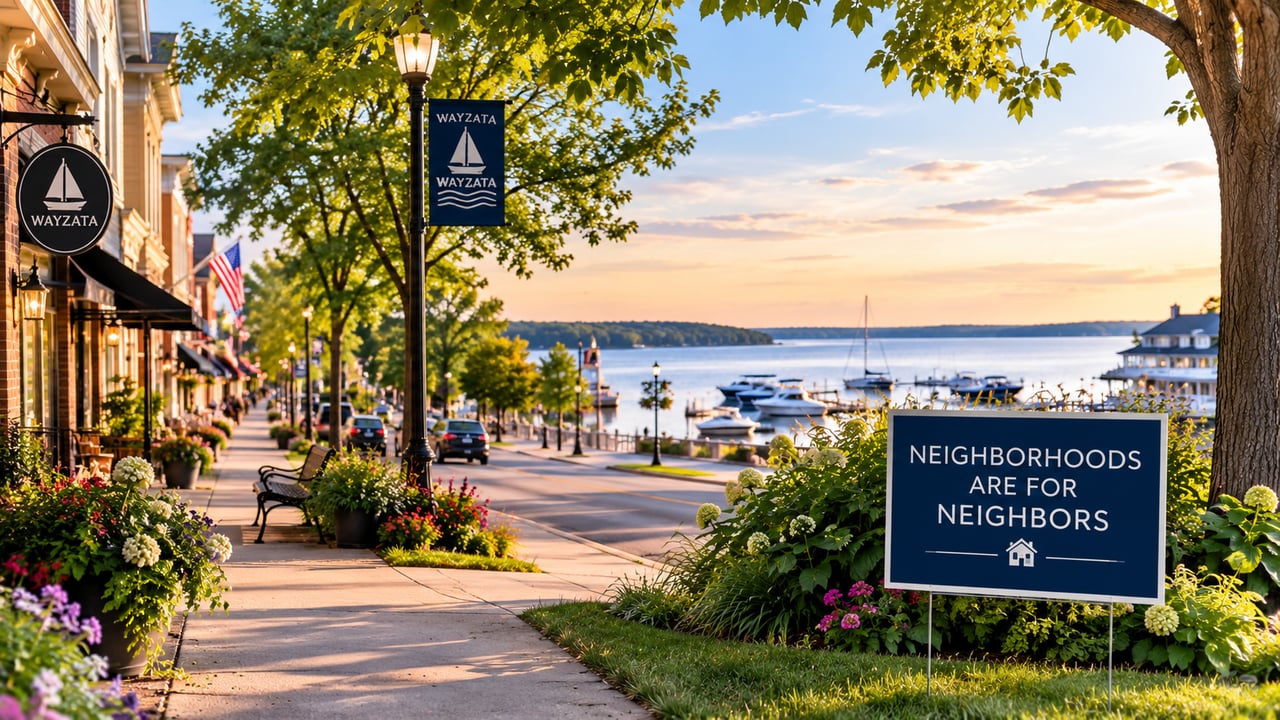
If you have walked along Broadway Avenue or Central Avenue this year, you have probably seen the yard signs. "Neighborhoods are for neighbors," a few of them read, planted in front yards a few blocks from Lake Street. You may have also noticed the closed meeting notices taped to the door at City Hall, or heard secondhand that the council spent part of a spring evening behind closed doors talking to attorneys instead of residents. Something has clearly been happening with short-term rentals in Wayzata. What most people have not pieced together is that the fight everyone assumes got resolved in court this spring was never actually about whether Airbnbs belong in a lakefront neighborhood at all.
That distinction matters more than it sounds like it should, because it explains why a ban that looked dead in March came roaring back as a moratorium by April, and why the city just filed an appeal in August rather than starting over from scratch.
How a Licensing Rule Turned Into an Outright Ban
Wayzata has been talking about short-term rentals since 2018, and the council formally made regulating them a strategic priority in 2023. The city's first real move came in October 2024, when it adopted an ordinance requiring STR operators to get a rental license, designate a local contact, and meet parking and occupancy standards. That licensing rule was meant to answer a basic question: how many of these things are actually operating, and where.
The answer, once the city started counting, pushed the debate further than licensing. By May 2025 the council was directing staff to hold separate engagement sessions with STR owners and with neighbors of STR properties. By August, staff had laid out a menu of options ranging from tighter licensing to an outright ban. On September 9, 2025, the council voted 4-1 to approve the first reading of Ordinance 852, which prohibited short-term rentals across the city, full stop, with no exception for owner-occupied homes. Council Member Ken Sorensen had floated a homestead exception at that meeting, arguing that someone who actually lived in the home should be able to rent it out short term. The idea got support from Council Member Jeff Parkhill but did not make it into the final ordinance. The second reading passed September 23, the ordinance was published October 6, and the ban was set to take effect once existing rental licenses expired at the end of March 2026.
The Count the City Never Quite Nailed Down
Here is where the numbers get interesting, and where the Sorensen compromise starts to look less meaningful than it sounded in the meeting.
The city's own short-term rental page currently lists 16 licensed STR units, with staff estimating up to five more operating unlicensed in condos or townhomes. A separate staff analysis from March 2025 put the active count closer to 18. The numbers moved depending on who was counting and when, which on its own tells you something about how hard this was to regulate with precision.
The detail that matters most, though, is ownership. City staff found that every one of the licensed units sat in single-family or two-family residential districts, and that only one unit citywide was owner-occupied. The rest were investment properties, bought and improved specifically to operate as short-term rentals. That means Sorensen's homestead exception, the compromise most likely to have satisfied both sides, would have changed almost nothing about the actual STR landscape in Wayzata. Out of roughly 16 to 18 active units, it would have protected exactly one.
The Judge Never Actually Ruled on Airbnb
A group of Wayzata property owners, including Adlon C. Adams, Olivia A. Adams, Wayzata Cottage LLC, and Robert C. Fisher as trustee of the Robert C. Fisher Trust, sued the city in Hennepin County District Court on October 17, 2025, seeking to block Ordinance 852. Their properties sat on Central Avenue, Manitoba Avenue, and Lake Street East, and the suit asked the court to void the ordinance and, if necessary, force the city into condemnation proceedings over what the plaintiffs called a regulatory taking.
On March 30, 2026, Hennepin County Judge Joseph R. Klein sided with the plaintiffs and voided the ban. But read the ruling closely and it is not a verdict on whether short-term rentals are good or bad for a residential neighborhood. Judge Klein found that Ordinance 852 functioned as a zoning ordinance, and that the city had not followed the procedures Minnesota law requires for zoning changes. In other words, the city lost on process, not on substance. Every argument about noise, parking, and whether a rental with nightly turnover belongs next to a family home in a residential district is still sitting untouched, waiting for a court that has yet to weigh in on it.
A Moratorium, Two Closed Meetings, and an Appeal
The council did not wait long to respond. On April 7, 2026, it approved an emergency interim ordinance imposing a 12-month moratorium on new short-term rental licenses, passing 4-1 with Mayor Andrew Mullin as the lone dissenting vote. Mullin's objection was not that STRs should be allowed. He wanted to understand the legal path forward before acting.
"I would liked to see the briefing on the case before we impose a moratorium to understand all the implications or the path forward, whether it be an appeal, whether it be moving to zoning as a remedy to address this or maybe going back to responsible regulations," Mullin said at the meeting. "So I think the moratorium is premature."
The council met in closed session twice that spring, once on April 7 and again on May 5, to discuss litigation strategy with its attorneys under the state's open meeting law exception for attorney-client communications. Then, on August 4, 2026, the city filed a notice of appeal with the Minnesota Court of Appeals, asking that court to review both Judge Klein's March 30 order and the subsequent June 5 judgment. As of this writing, that appeal is pending. The moratorium the council passed in April runs for twelve months, meaning no new STR licenses can be issued in Wayzata through at least April 2027, regardless of how the appeal turns out.
The Argument Underneath the Legal One
Strip away the ordinance numbers and court filings, and what is left is a genuine disagreement among neighbors that predates any of this litigation.
At the September 2025 council meeting, resident Penny Sherry described living next to a unit booked nearly every day, calling it "a full-scale commercial operation in a residential area right next door to us in an area that's not zoned for it." Dave Larson, a Wayzata resident of more than 20 years, worried that STR guests "don't have a strong commitment to the community and certainly not to the neighborhood." Scott Tripps, who has lived in Wayzata for 30 years and owns a short-term rental near his own home, pushed back, telling the council that STRs "can have a positive impact in neighborhoods when they are operated responsibly and respectfully."
None of that testimony has been legally resolved. It was the backdrop for a vote that got overturned on a technicality, which means the actual disagreement between people like Sherry and people like Tripps is exactly where it was a year ago, just with an appeal now attached to it.
What This Means for Fall and Winter
For residents watching this play out, the practical takeaway is that nothing changes quickly from here. The moratorium keeps new STR licenses frozen through next spring no matter what the Court of Appeals decides. The roughly 16 to 18 units already operating continue to do so, since the ban that would have shut them down was voided. And the deeper question, whether Wayzata can regulate short-term rentals the way Ordinance 852 tried to, sits with an appellate court that has not yet set a hearing date.
This is also a city with a lot on its plate at once. The council spent the same spring managing Highway 12 construction impacts on downtown access while also formalizing Aurora Yager's appointment as city manager, a role she had held on an interim basis since October 2025. The short-term rental fight has not gotten less attention because of that. If anything, the closed sessions and the appeal suggest it is getting more.
If you live near one of Wayzata's downtown-adjacent streets and have wondered whether the sign in your neighbor's yard means anything changed, the honest answer is: not yet. The legal fight is still open, the moratorium buys the city time without answering the underlying question, and the residents on both sides of this are still waiting for a court to actually rule on the thing they have been arguing about since 2018.
If you have questions about how any of this touches a specific property, or you are simply trying to keep up with what is happening in your part of Wayzata, Anne Rybarczyk Gray has spent 25-plus years working in Twin Cities neighborhoods just like this one. Let's Connect.